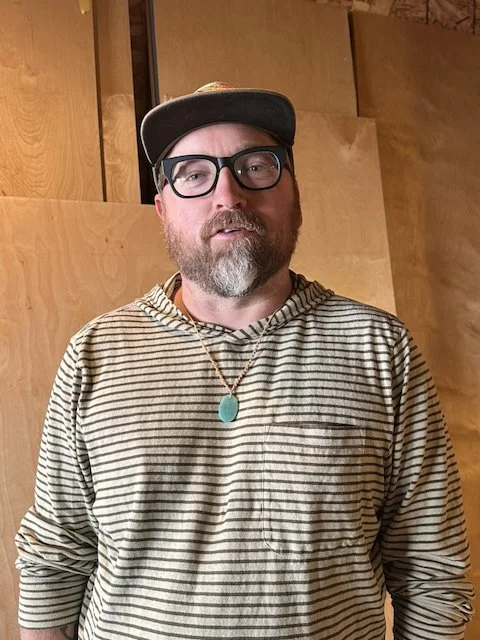
Bear Erickson is a gifted guitarist, sound technician, and family man, but none of this encompasses the fact that he is also a passionate advocate for community, a sort of philosopher, and a force for good. I sat down with him for an hour on a Sunday afternoon, a day that had begun with an “open mic” session, a monthly event he facilitates at Lefty’s, a coffee shop in Los Olivos. It is a privilege to share our conversation here, which I think reflects his insight, humility, and spirit.
CW: I was so moved by the open mic performances this morning, and I’m remembering something you said, that a concert is about change. You told us to think about what we felt when we walked in and notice how we felt afterwards. I felt inspired, uplifted, a little more hopeful. Can we talk about what led you into this generous way of bringing music into the community? What is your background? It seems to me that you live your life in an intentional, unusual way.
Bear: I’ve been living in the Santa Ynez Valley my entire life. I left for one year to go to the Los Angeles Music academy in 2001. There were only three Americans, everyone else was a foreign student, and on my third day there, 9/11 happened. Almost half the school’s families pulled them home, back to Brazil, back to Sweden, back to Japan. We were left with a class of seven people. Suddenly my college class felt very much like Dunn Middle School. My car had been stolen in Mexico the week before I went to college, and so I was living in LA with no car, which is not really the city you want to have no car in. I would walk to school in the morning, and that was the first time I saw people with signs that were anti-brown people, or anti-guys with beards. This was the reaction to 9/11. I had never seen anything like that before. And that was the beginning of my adult life. My entire adult life has been witnessing the thread being pulled from the American sweater. At this point, it’s just a pile of thread on the ground. It’s frankly embarrassing how the world sees us. I feel very let down as to what it means to be an American.
And I love to travel. I love to go to Japan. Music has taken me around the world, and it’s sobering to see how Americans are viewed. People are scared of Americans, and they’re also laughing, but it’s like nervous laughter at the bully who also has the biggest gun. People in other parts of the world don’t know what to do with us now, and we don’t know what to do with us, and it seems to me that the only option left is for us to live our lives on a local level. That’s why I’m at this point.
CW: I understand that, and I feel it, but I also have a great hope that living on the local level is a seed or has an expansive ripple effect. We’re all interconnected on this planet after all. But yeah, what else can we do?
Bear: I was raised by an amazing mixed generation, the Greatest Generation and the Boomers, all mixed in. Growing up in Los Olivos in the 1980s was the most magical thing. I grew up in Solvang, Los Olivos, Santa Ynez. The whole Valley has been my home. Coming into the world, the first two hands that ever touched me were Louie Netzer’s. He birthed me. His son Michael was about my sister’s age.
For the generation that was in the Valley at that time, complaining just wasn’t even a part of the culture. So if you didn’t have a little restaurant where people could meet, instead of complaining about it, Lou Netzer made Side Street Café. Kids were all allowed to work when we were really young, so work wasn’t just some negative thing you did to get money to buy material items, work was how you participated in the community. We all worked at Our Country store, and John Blossom’s pottery studio…there was such an incredible foundation of community in my life! When Lou Netzer created Side Street, as far as I was concerned, that was the place for discourse. He nailed it. I got to see people having arguments over great food from Anne Bunch or Annie Greenough, and the arguments were never personal. They were about how people perceived a problem, and they were arguing about a solution, as opposed to just ripping each other down. You could see back then how much more got done when people had the intention of wanting a better town or were worried that too many kids are drinking and driving, or whatever the problem. There were people on all sides of the aisle jumping in to make a better community.
As you and I talked about earlier, the hollowing out of the American dream has also come with the outsourcing of everything. This is how we got to the outsourcing of our own time, the attention economy, where if you’re awake for twelve hours in a day with the tech giants, the people in power, how many hours are you willing to stare at a screen at their propaganda, or their stories, or whatever they are calling it, as opposed to getting out and raking your yard, or shaking your neighbor’s hand, or helping a kid pump up a bike tire?
The things that happen in the real physical space are what give you a sense of meaning and worth. And in this Valley, when I look around at the talented people, it amazes me. I mean, consider our farmers around here--you want to know how to work hard, look at the farmers, look at the farm workers in the fields. If they’re able to wake up and work this hard and on a weekend celebrate their family and culture with whatever time they have, there is no room for me to complain. Even though the Santa Ynez Valley is dealing with some pretty rough stuff, I do feel that the possibilities are right in front of us, but it’s hard work: we see what it takes to grow food, or if you want to start an open mic, or a little parade, it’s do-able. It’s hard work, but it’s not work to shy away from either, because it gives back so much to you.
CW: How would you describe yourself? Are you primarily a sound engineer? A musician?
Bear: It depends on what profession you’re in, but in the music business, sometimes people have to put their biggest accolades right on the front page, because that’s how they get a gig, and that’s fine. But there are those of us for whom even mentioning the big names we played with feels a little icky. So the balance for me is something like this: musician, artist, dreamer, father. In no particular order, because obviously right now my number one thing in life is being a partner to Adrianna, and a father to my son Bjorn. My little family that’s going on is blowing my mind, the depth of family!
And I am a pacifist. I’ve never had to hurt anyone in my life to get further down the road. As I said, starting in college, we’ve been in war my entire adult life. We’ve been bombing schools and killing people abroad who we don’t know based on subjects we’re not versed in and arbitrary motives. If you’ve got your own family, you think about it: How could I go do that to a family somewhere in the world?!
I grew up on a horse ranch on Ballard Canyon, and there was art around all the time. Both my parents are artists. My mom was a painter at RISDI and went to Kansas City Art Institute for ceramics and then, dissatisfied with the art scene, she went into landscape architecture. She had grown up back East, in a little town outside of Harrisburg, walking the woods in Pennsylvania, and she shifted her painting and illustration talents into drafting of gardens. My dad was “Painter of the Year” at UC Irvine when he graduated. Just having a West coast dad and an East coast mom is a super blessing.
My partner Adrianna and I are extremely different people. We find that to be our superpower and a positive thing for our son. My mom and dad are also totally different, and I value both of their takes on things. But my mom’s epiphany was realizing that you could do art with gardens. Whether it’s Japanese gardens or English gardens, or any of the traditional gardens, or native plants, botanic gardens, that’s the meaning she has found. She does art with nature, and it is hugely inspiring. My dad quit painting and started doing collage art in the 1970s. He’s been doing collage ever since. He also builds guitars, and everything he does is artistic…he just can’t help it.
CW: I understand that you are in the early stages of developing a nonprofit organization called MAS (Music and Art Support) and I wonder if you could tell us a little bit about it.
Bear: It’s going to launch in June, and I’ll be more ready to talk about it then. It’s about more music, more art, and more community.
I can tell you that what MAS will focus on is restructuring the culture of music community-wide. MAS will provide private lessons, group lessons, events, performances, experiences, and eventually a brick and mortar where I’d love to see, say, 15 years down the line where we have an arts park, a physical park with buildings on it for learning ceramics, music, dancing. One of the things about our American culture is that growing up in the arts the first thing we do with the arts is separate kids. If you’re a dancer, you go here and you don’t hang out with the musicians. But dancers dance to music. It’s totally weird that musicians and dancers don’t hang out more. Or if you’re in ceramics, you go over here and you don’t’ hang with the painters. You don’t hang with the theater kids. There are a number of places in the U.S. that inspire me about how the arts are being woven back together. One of them is right up the road at Alan Hancock.
But every single thing that we do will be sliding scale. There’s a huge need in this community for people who do not have extra money to be able to participate in concerts, where they could bring their family, without breaking the bank, to be able to get private or group instruction, whatever works for their finances, and to know that they are seen. One of the reasons I’m calling it MAS is I live in a bilingual household, and I’m not sure I’m seeing support for the Latino community, such as concert series where we have some of the shows in the series in Spanish. I would like to offer half of our lessons in Spanish. For me personally I feel the Latino culture in the Santa Ynez Valley deserves more visuals, more representation. Not just thanks for providing services. I would like to see the Latino side of the Valley raised up by their own and raised up as a whole and given more options. I would like to see the Valley open itself up to how much of our community are hard-working brown people who are absolutely wonderful.
We have exciting plans for the summer, but it’s all under wraps right now. Let’s talk about this in June.
CW: We’ll get the word out then. What inspired the open mic sessions? I’m here to document and tell the stories.
Bear: It’s the idea that where can we go in the community right now for a musical experience that’s all ages, doesn’t cost anything, and is not based around alcohol. I started it at Lefty’s about three years ago. Lefty’s to me is the closest I’ve found, vibe-wise, to the old Side Street. I felt it was something special and if I could be part of it I would. Open mic is one example of a healthy way to experience music and art. I’m just trying to do one thing for the community right now.
Telling the story is another important function of community—isn’t it? Not only having a role but having a community that helps you figure out what your role is.
My role in this community when I was 17, was running Jensen’s Music on the weekends when I wasn’t in school during the week, and delivering pizzas for Antonios, and working at Back Door Board Shop. I was a young ranch kid. To be in a guitar shop working and they were teaching me and I was learning, and the pizza place where they told me I could drive…I knew every back road in the Valley…so I got to listen to music and deliver pizza, which I thought was just like the coolest thing, and then working for Holly, living around here we don’t have snow, I eventually got to be one of the chaperones on the snowboarding trips, that was my job in the community then, but that’s not my job now. I’m a different person, in the exact same community. That’s one thing that a healthy community does. It allows people to become new versions of themselves in the community.
Let’s take an example from the open mic today. We all heard a young woman, Arrow, performing a poem by Amanda Gorman. She reorganized my molecules today. I know from what we heard today that if she was on the ballot for president in 2040, or as soon as she is eligible, she might win. Right now, she is a 12-year-old girl who is learning, and our current role is to provide an open mic or space where someone like that can flourish. I just know that in twenty years, if she were to stay in this community, what an asset she would be!
CW: She blew me away too. But on the other end of the spectrum, there was that old couple Byron and Teresa singing that sweet Guy Clark song, “I Don’t Love You Much, Do I?” and it was so tender and touching. So many things happened at that open mic!
Bear: Being in the professional music world for twenty-five years now I have been very fortunate to work with people who are famous and not famous. I’ve had numerous famous friends who have told me how miserable they are and how they were on tour their whole life while their kids were growing up, and one of my friends said you get on the bus and leave your family for six months a year for twenty years and you take your son out for dinner and when he’s 23 years old and he looks at you and you think, this guy doesn’t even know who I am, and everything I was doing was for him. Whether it’s the fact that being on the big stage for a living isn’t quite in my blood, or because people who have done it tell me what it’s really like, but making it big has never been my quest.
Once I was asked to write music for a scene I hated where a cocaine dealer was holding a gun to the head of a 5-year-old, and I told the guy I didn’t sign up for this. And he said, “Yeah you did. It’s just a scene. Write the scene and get it over with.” But I knew I was not supposed to be using my musical talents for this. And I don’t want to judge any of my friends who have worked so hard in music to either go on tour or run a studio or play at the Oscars, whatever they want to do. It’s just a different kind of choice.
For a long time, it was hard to feel validated for choosing to stay in a small town. A lot of people wonder if you’re scared of something, but I remember being on tour in New Zealand and finding all these beautiful towns that just reminded me of the Valley, and I saw all these wonderful happy farmers and people, and I thought, “Wow, where I live makes me tick, and has given me so much.”
My mom told me this: “When you are ready to lose sleep over something, when you are ready to stay up late for something, when you are ready to put every contact you have on the line for something, then you need to decide that this something is for community.”
That’s where I’m at. I’m leaving making records for a living and entering the nonprofit world, which is completely a new skill set for me. There’s a lot of people in the Valley that have known me for decades and I’ve never asked for a dime because I didn’t have the right spot to put the dime at that point.
I have an incredible round of mentors…once again, growing up in the Valley, mentorship when I was growing up, was huge…. whether it was John Blossom for pottery or Dorothy Jardin for poetry….and you just go down the line. There were mentors everywhere. When I think about our current culture, the fact that everyone has to pay for private lessons—and by the way, I teach private lessons for a living and I understand how expensive they are, and how difficult it is for people––but we’ve created a culture where there is no time for students to have mentorship, and I do know we can change that around slowly.
But I really feel that the Santa Ynez Valley is such a great microcosm of America right now. We know we cannot keep going like this. It’s not working, for not only people on the left or people on the right, but this valley has so much. We are capable of being such a better place.
And I don’t mean cooler, I don’t mean a place in the next magazine, it’s the idea that when people talk about our Valley and don’t live here, they say, “You know what? Everyone there is really kind.”
That would be an amazing place to start. Then they could say, they’re kind, and look how talented they are. Or they’ve got bakers, and they’ve got farmers, and bands, and teachers. If we could just start with the kindness bit.
For me personally, as I see it, I don’t see a Valley that is only full of hate. I see a Valley that is full of everything. Luckily, because of where I frequent and where I hang around, I see a lot of inspiring people who just blow me away with not only their skills but their tenacity for caring. Like anyone else, I feel like some days I’m just running out of energy. Then I hear Arrow today or I get to play a song with Byron and Teresa and I go, “Man, if they’re doing it, I can do it.”
CW: We need to keep fortifying each other. We need to see each other.
Bear: I always tell people I was raised in the Santa Ynez Valley by fifty earth mothers. When I grew up in Los Olivos, you could be reprimanded by any woman in the town. I will tell you, raising kids nowadays, the current crop of parents are such incredible people, and it’s just so different. I kind of thought I was gonna raise my son just like I was raised, but the same rules don’t apply. Modern parents have to figure it out; I just want to see the boys riding around on their bikes with no parents hovering, but we need parents too because of what’s going on.
I was raised in a culture where the men I was around were not scared of strong women, and the strong women were everywhere in the Valley. And I’m attracted to being around strong women, by which I mean independent, educated, thoughtful, rightfully opinionated community partners. We live in the age of gender fluidity trying to figure out all these things, but man, I just know I was raised on a horse ranch by my grandma! My parents were there, but everybody was working, my grandfather had passed away before I was born, so my grandma and I spent a lot of time together, and she was a tough cookie, and I have to say in the Valley growing up, there wasn’t a thing a guy could do that a woman couldn’t do. I think there is a certain part of American culture right now that highly educated strong women are not really welcome.
But a quick story: In 2005, I went to make a record in British Columbia with my friend Omar. We went up to meet this guy Joby Baker. Omar’s dad was a shaman, and had been doing this record with Joby, who became a mentor of mine and now we’re like brothers, and I remember thinking that a guy this amazing must have a remarkable mother, and I have to meet her. I asked Joby, “What’s the story with your mom?” He says her name is Jaki Whitren and she lives in France, and if you want to go see her, why don’t you just go over there? I said, I think I will.
So I ended up going to Europe and driving a little car from Barcelona up to this place Clos du Pont in Brittany to meet Joby’s mom. He said, just so you know, her place, a 600-year-old farmhouse, is a commune, so who knows who will be there, so be prepared, all sorts of people may be there. But when I arrived, it was only her; even her partner was in London, so it was just her on the property. And I remember having the greatest time with her, and I felt so moved, and so connected, and before I left I asked, “Jaki, why do all my friends live thousands of miles away from me?”
And she said, “Bear, if all the bright lights were in one spot, it would be dark everywhere else.”
When she told me that…the reason I bring this up…she said, “If your light is feeling a little dim, you just need to make the journey to hold it next to one of the bright lights that you admire.”
I left her house like I’d come halfway across the world for one sentence. She and her husband have passed on, and I felt so fortunate to have had this 5-day hang with her.
CW: But it wouldn’t have happened had you not had that special kind of openness and gone out of your way. Most people would not have even imagined the possibility.
Bear: I am working on being my best self, and I would love to be in a community where we support each other. Taking the time it takes to be our best selves. We know our own demons, the things we struggle with, but if you knew you had a partner or a friend, or someone at a coffee shop you could talk to that is supporting you working on yourself, just a little every day, that’s such a change for people who don’t have anyone or wouldn’t want anyone to know I struggle. That’s community. A town is not a collection of buildings. Who bakes the bread? Who cleans the park? Who grows the tomatoes? Those people deserve to rest their heads in the same town.
And let there be music. Before the advent of concerts, 90 percent of music played on planet earth was played by the same people that were listening to it. Whistle while you work, that sort of thing. I’ve seen the culture of going to the biggest stadium to watch the pop star, and that can be an entertaining and exciting evening, if that’s what you think music is, rather than the piano in your house and your grandma plays. But we’ve commodified it. As soon as we turned music into an object, it became strange, because and object can be bought and sold. Music is not an object Music is something you do like running or dancing you play music or listen to music. It’s not a thing. Our culture commodifies everything.
CW: What are you most proud of?
Bear: Absolute number one is my relationship with Adrianna and my son Bjorn. I’m most proud of my family. I took my son to YoY o Ma the other night, we had been to Monster Trucks in Anaheim the night before. Yes, in 24 hours we went from Monster Truck to Yo-Yo Ma. But during Yo -Yo Ma’s performance, he was waving his bow at the audience like he wanted us to start chanting with him, and then we were all singing in the Granada, and I realized my son and Yo-Yo Ma were singing in the same room together, and it was one of those moments! Whether it was Bjorn meeting Kamasi Washington or Jacob Collier during a concert, Bjorn says these little things at such moments that just hint to me that he is such a great human. I have no clue what he’s gonna do, and we are going to support it, but we’re working on fostering the good human, and kindness, and I know there are so many people doing that. We’re not isolated in this. All the parents I meet, the current crop of parents, everyone is trying to do their best, and I see these kids.
I feel informed about what’s going on globally, internationally and locally. But the powers that be in media do not give equal representation into what needs it. I tell people just go to a park, say hi to someone, and I guarantee there’s gonna be a cool person. That’s what’s actually going on.
At open mic today there was a new cowboy; he had just taken a job running a ranch on Jalama Road and he and his wife were new to town, and then that guy sang, and I thought this is just another amazing human who just walked into a coffee shop, and the more we can open doors to people, say hello to someone we don’t know, I think we’re gonna be living in a place that we really value while we’re here.
CW: I hope so; I think so. What is your current state of mind, Bear?
Bear: Listen more. Make more space for others. Welcome those who are cold to the fire.
CW: Wow. I usually ask folks if there is any message, advice, or wisdom they would like to share. You’ve sort of done it right there.
Bear: Well, one thing we didn’t get to talk about, a big topic, is AI. I read a lot of work by Yuval Harari, who has written about AI and how it is sort of hacking the operating system of human civilization. If I had to put it in bumper sticker terms, I’d say: VOTE FOR HUMANISM. Most of the things making our culture sick is technology. And I’m a guy who runs a recording studio with all this technology, but I would just say ask yourself if a human made it or not, and if you can, vote for humans. Because we have the gift in our life right now of being on the track where we get to pull the big lever, and after we pull this certain lever, other generations are gonna have to deal with the consequences of that. They won’t be able to get the train backwards to this decision. So we have a huge responsibility to vote for humans. And I mean that in a very broad sense. But if it’s the person who takes care of your child, the person who plays music for you, the person who lights the candle at the restaurant, these are all humans, and they are worth whatever the cost is to have humanity. Yes, humans work on computing, but this is a tool that is so specialized and dangerous it should not be unleashed on the general public. We barely made it through social media.
Another thing, I wish we could create a government for the people by the people, as we say in our own documents. Until we can follow that, we’ll be the laughing stock for a while. And it doesn’t feel good to be the laughing stock when you’re trying so hard. It frustrates me that my Canadian friends feel sorry for me. Or they laugh about how sad it is.
CW: We have to take the heartbreak and anger and find the light in our brokenness. I see you doing that. You are one of the heroes, Bear.
Bear: Most of my friends are in their late 70s; I’m turning 44 this month. You met my dad, you see how hard he’s working. I’m thinking thirty more years of working this hard. It’s frankly intimidating. But it also lets me know I don’t have to do it all this year. If my nonprofit starts, I know the vision I have is going to take a long time, but I’m moving from being behind a guitar in my life to being behind more projects.
And maybe I opened the door for someone who was having the worst morning today.
CW: You did, Bear. I know that you did. You are changing lives. Don’t underestimate yourself.